
Tag Archives: Super7 Operations

Visual Management for Teamwork – the Team Board

Visual management creates the openness and transparency that are essential for Lean teamwork. Each Lean Team should have a team board, to my opinion. In true Lean companies this is common practice, but in Financial Services I have encountered Lean teams without one. Not so in one department that I helped with the introduction of Lean, or more specifically, a Lean way of working tailored for Financial Services – Super7 Operations.

The benefits that we found from the use of team boards are:

  1. Team pride. Teams are proud of what they achieve, and of the improvements they have made. In this department, each Super7 team chose a team name – often a bit tongue-in-cheek – that was displayed at the top of the board. Often with pictures of the team members matching the theme of the team name.
  2. Output management: Each team shows their progress against the daily target, updated 4 times per day. The manager can see where help is needed, even before the question for help has been asked.
  3. Continuous Improvement: Each team shows the Kata-improvement or the experiment that they conduct that week. And some teams include an improvement idea list for improvements that go beyond their own team scope – which for instance the IT department can work on.
  4. Learning. Weekly dashboards are displayed on the boards, and ‘red lights’ are celebrated as improvement opportunities. And the evaluation of Kata-improvement actions is also displayed on the board: “what did we learn from this experiment?”
  5. Open and Transparent culture. Teams have nothing to hide from each other, from the management or from visitors. All results, good or bad, are displayed with pride. Good results as successes, bad results as learning opportunities.

If you are familiar with the use of team boards in production or assembly plants, as is explained in detail on www.lean.org, these benefits won’t be surprising. The question remains, however, why there are still lean teams in Financial Services that haven’t adopted this best-practice.

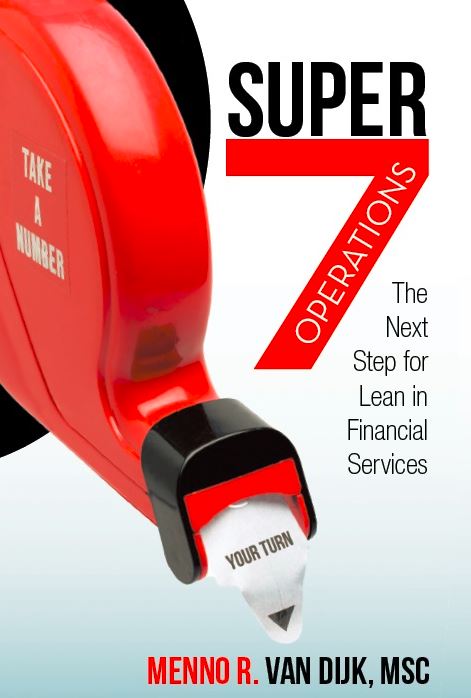
More information on Super7 Operations can be found in my book: Super7 Operations – the Next Step for Lean in Financial Services.

My book explains the theory of Super7 Operations in detail as well as giving practical guides for implementation of Super7 Operations in the detailed case studies. You’ll get valuable tips and tricks for implementing Super7 in your own organization, from the people that have done it before you.

Menno R. van Dijk.

Super7 Operations - The Next Step for Lean in Financial Services

Kata Coaching in practice of Lean Super7 Operations: keep it simple

Kata coaching has successfully been used in practice, in organizations that have adopted Super7 Operations. One important lesson: keep it simple, keep the improvement steps small.

Recently, Super7 Operations was introduced at a debt management department. The team managers responded very well to the step-wise improvement method of Kata. However, they sometimes found it difficult to accept that the goal for next week would be anything less than reaching the desired condition. This lead to too many actions on the action list, that couldn’t all be finished within one week. To my opinion, this one-week rhythm is essential for maintaining momentum in the early stages of development of Super7 Operations. The lesson that we learned is to keep the improvement-kata simple: one action in one week, one experiment, one problem to solve. The improvement steps may seem small, too small perhaps, but in our experience this is in fact the maximum improvement pace for the organization.

The Kata Coaching Questions (my own free interpretation – please refer to www.lean.org/kata for the standard):

  1. What does perfection look like to you on this element of Super7 Operations?
  2. How does the current situation look like?
  3. Where do you want to be next week on the development of this element of Super7 Operations? And what obstacles are preventing you from being there now?
  4. What action or experiment will you take to get to where you want to be next week?
  5. What do you expect from this action?
  6. When will be able to evaluate what you have learned from this action or experiment?


 Theory and examples of Kata coaching can be found on www.lean.org/kata or in the excellent books and you-tube posts of Mike Rother.

Super7 Operations - making it work

Soft Skills for cooperation in Super7 teams

What soft skills are needed for cooperation in Super7 teams – what soft skills are essential for a team to reach cooperational excellence? The implementation Super7 Operations (link) within the operations departments of one of the leading Dutch retail banks is in full swing. Many things need to be taken care of in the preparation phase: small, autonomous production teams (Super7’s) arent’ formed overnight. But one thing in particular is essential for a smooth introduction of Super7 Operations: attention to the soft skills that are needed for working together in a small, autonomous team.
In our experience, the most important soft skills for cooperation in Super7 teams that required training in preparation of Super7 Operations are:
1. Giving and receiving feedback
2. Understanding the development of autonomous teams
3. Effective meetings and making decisions as a team

Let’s look at these subjects in a bit more detail:
1. Basics of giving feedback
• Describe what behavior you have observed
• Explain what effect this behavior has on you
• Check if the person you give feedback understands you
• Indicate what behavior you would like to see

2. Basic development steps of autonomous teams
• Phase 1: group of individuals
• Phase 2: a developing team
• Phase3: a cooperating team
• Phase 4: an autonomous team, striving towards cooperational excellence

4. Basic elements of effective meetings and making decisions as a team
• Use team roles in meetings: chairperson, time keeper, voice-of-the-customer
• Make sure all items on the agenda are well prepared
• Assign a fixed amount of time to each item on the agenda
• Start with giving all participants the chance to say something about the subject – finish the initial round before starting the discussion
• Use a white board or flipchart to write down the most important points
• Keep the focus on solutions and improvement ideas
• Make sure everybody gets their say
• Keep the discussion focused
• Don’t take minutes, write down actions (what, who, when)

For the team managers, the change from traditional Operational Management to Super7 Operations can be even more dramatic than for the team members themselves. More on this change and the required skills for managing Super7 Operations can be found in my book: Super7 Operations – The Next Step for Lean in Financial Services. More information about this book can be found on www.super7ops.com

How to apply Kata Coaching in implementation of Lean Super7 Operations


Kata coaching is especially useful in the implementation of Super7 Operations. The theory and examples of Kata coaching can be found on www.lean.org/kata or in the excellent books and you-tube posts of Mike Rother. Recently, I’ve applied Kata coaching during an implementation project of Super7 Operations.  Every week, I used the Improvement Kata questions to challenge the team managers to make one improvement step on each of the 7 principle elements of Super7 Operations. And in turn, the team managers have used Kata coaching questions to get their teams to improve. The effect of applying the Kata coaching questions to the 7 principles of Super7 Operations was impressive: not only did this lead to exiting improvement experiments on the shop floor, but it had a profound effect on morale as well.  I have found that Kata coaching is an effective way to get and keep things moving towards the desired direction. It just isn’t possible to implement perfection in one blow, and this isn’t any different for Super7 Operations.

The 7 principles of Super7 Operations:

The 7 principles of Super7 Operations

Principles of Super7 Operations

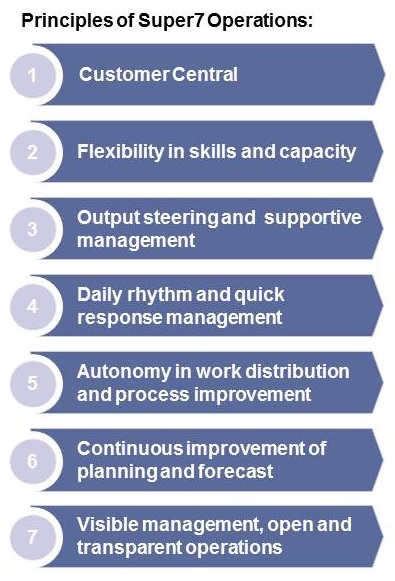
  1. Customer is central: The Super7 team has a goal that is relevant for the customer.
  2. Flexibility in skills and capacity
  3. Team manager steers on output and is supportive to the Super 7 team
  4. Daily rhythm and quick response to disruptions
  5. Super 7 team is autonomous in work distribution and in imporving the way of working.
  6. Continuous improvement of performance, supported by planning and forecasting.
  7. Visible management to create openness, transparancy and Super 7 team pride.


The Kata Coaching Questions (my own free interpretation – please refer to www.lean.org/kata for the standard):

  1. What does perfection look like to you on this element of Super7 Operations?
  2. How does the current situation look like?
  3. Where do you want to be next week on the development of this element of Super7 Operations and, what obstacles are in your way?
  4. What action or experiment will you undertake to get to where you want to be next week?
  5. What do you expect from this action?
  6. When will be able to evaluate what you have learned from this action or experiment?And afterwards:
  7. What did you learn from this action / experiment
  8. …start again at step 1

 More on Super7 operations can be found in my book: Super7 Operations – the Next Step for Lean in Financial Services.

Super7 Operations - the Next Step for Lean in Financial Services ; a book by Menno R. van Dijk

Super7 Operations – the Next Step for Lean in Financial Services ; a book by Menno R. van Dijk

Super7 Operations - The Next Step for Lean in Financial Services

The 7 principles of Super7 Operations – what does good look like?

Successful implementation of Super 7 Operations – the next step for lean in financial services – depends on the introduction of all 7 principles of Super7 Operations: 1. Customer central, 2. Felxibility in skills and capacity, 3. Output steering and supportive management, 4. Daily rhythm and quick response management, 5. Autonomy in work distribution and process improvement, 6. Continous improvement of planning and forecast, 7. Visual management – open and transparent operations. 

The 7 principles of Super7 Operations

Principles of Super7 Operations

Naturally, the introduction of the principles of Super 7 Operations is best done step-wise. However, it’s good to start with the end in mind:  what does good look like in Super 7 Operations?


  1.  The Super7 team has a goal that is relevant for the customer. The Super 7 team can help each other in achieving this goal. The goal is translated daily to a goal for that day. The Super7 team is committed to achieving the daily goal. When problems arise during the day and the daily goal can’t be met, the Super 7 team responses by doing what they can to come as close as possible to the goal. When that isn’t enough to reach the goal, they ask for help from their team manager. The request for help is quantitative and specific. For instance: we come 6 hours short, we solve 4 hours ourselves and ask for 2 hours help from another team.
     
  2. All Super 7 team members have the skills for all types of work. The Super7 Skills-Matrix shows who can do what, and at what skill level. The Super 7 team members are sufficiently flexible in working hours to be able to meet customer demand on busy days. 
  3. Team manager steers on output. Manager stimulates the Super 7 team to  come up with solutions. Manager is available and helpful when the Super7 asks for help. 
     
  4. The daily rhythm is adjusted to the rhythm of the customer requests. There is a fixed schedule for Super 7 team stand-up meetings, focused on achieving the daily goal. When incidents happen, the department responses quickly in constructive and effective dialogue between Super7 team and their manager, and subsequently between the team managers and the department head.
     
  5. Super 7 team is autonomous in work distribution and who does what. There is a standard way of working. The team can deviate from this standard, as part of an improvement experiment. The duration of this experiment is known beforehand (optimally 1 week). Evaluation is based on facts and figures. Most important outcome, however, is what the Super7 team has learned from the experiment.
  6. The Super 7 team is stimulated to continuously make the daily goals more challenging. Standard norm times are improved and planning is made tighter. Work is planned based on forecast. The organization continuously strives towards improved forecast accuracy and improved performance. Performance is discussed on all level of the organization. 
     
  7. The Super 7 team board is neat and easy to read. Daily goal and progress towards this is visible on the Super7 team board. Performance of last period is visible, as is the trend. Running and planned experiments and improvements are visible on the Super7 team board. Fixed lines are made with tape, fixed headers are printed.                                                                  

 More on Super7 principles? My book on Super7 Operation – the Next Step for Lean in Financial Services – is available in bookstores! 

How to apply Super7 Operations without TITO

Is Super7 Operations possible without TITO, you might wonder? (Or, “What’s a TITO?”)

In my book on Super7 Operations (Super7 Operation – the Next Step for Lean in Financial Services), I describe the development of Super7 Operations – Lean and Operational Management with small autonomous teams. One of the crucial things in Super7 Operations is that there is a daily goal for each small autonomous Super7 team – one that they can reach by working together, by helping each other. In the first departments where Super7 Operations has been introduced successfully, this goal was to work TITO: Today-In, Today Out. All customer requests that are received today are processed today -finished today, the customer shouldn’t have to wait.  The team’s common goal is: finish all customer requests that you receive today or at least those that you receive up to one hour before closing time. The fluctuation in ‘demand’ isn’t buffered with inventory, but is answered with sufficient flexibility in capacity.

Recently, Super7 Operations was introduced in several operational departments where the nature of the work made it impossible or extremely impractical to work TITO. Request that take more than one day to process, in one instance. In another, extreme peaks and lows, with almost all requests of one month coming in in one single batch (Naturally, batches are evil (to summarize one of the principles of Lean to the extreme).  But sometimes batches happen).

We have found that it is possible to work with other daily goals than TITO. This requires more sophisticated planning, for one, to translate the total demand into daily goals. Working with goals like TITO+5 doesn’t work, as we experienced. The team needs to have a clear goal for each day, which is higher when demand is high and lower when demand is low. Only then you get the commitment, improvement and cooperation that you expect from Super7 Operations.

If you’r interested in how this planning for daily goals works, please drop me a note below. I can give you more details, if you want. Or, you can join the discussion on www.super7ops.com

Maturity Model for Autonomous Super7 Operations Teams

At this moment, Super7 Operations (link) is applied within several operations departments of one of the leading Dutch retail banks. A lot has been learned since. The change from strict daily steering to small autonomous teams –and at the same time keeping all the good things from LEAN and Operational Management – has asked a lot from both the shop-floor employees and their managers. What we noticed is that teams go through several phases, or maturity levels, in their journey towards autonomy. And, team managers need to grow towards supportive leadership and output steering – this too doesn’t happen overnight. 

When we recognised this, it became clear that a maturity model would be very helpful. With this, the transition can be broken up into smaller, more manageable steps. And, for each maturity level, specific training and coaching can be developed to support both managers and Super7 teams.

The maturity model is still a work in progress, and at the moment only available in Dutch. If you’re interested nonetheless, you can request a copy by replying to this post. And, I expect to be able to post an English version of the Maturity Model for Autonomous Super7 Opertions Teams on this site shortly.

I would like to hear your experiences with the development of autonomous teams. You are invited to join the discussion on Super7 Operations on http://www.super7ops.com/

A new book on Super7 Operations!

Super7 Operations –  a book by Menno van Dijk 

(tip: clik the link above ↑ to buy the book at amazon.com)

 Naamloos


“Why did you decide to write this book on Super7 Operations?”

–          “To me, Super7 Operations is the logical next step for LEAN in financial services. I’m proud that we developed this innovation within ING. I’m so enthousiastic about it, it would be fantastic if this innovation would spread across the financial world. So much more can be achieved with LEAN than cost reduction alone. LEAN can become the culture within which people truly work together to improve every day.  That’s the foundation of Super7.  We believe in the abilities of our people, we trust them and give them responisibilities, and we steer on output. This improves the service to our customers. And, LEAN becomes FUN again! I had to write a book about Super7 Operations, to give as much people as possible the chance to learn about it.

“What were the reactions so far?”

–          “Very positive indeed! That started already with the publiser: the book was selected as “Editors Choice”,  something that I’m very proud of. And the feedback that I have received from readers has been great too.”

“Are you planning to write more in the future?”

–          “Well, we have been working on developing Super7 Operations further within ING. The method has been introduced in much more teams, some with totally different type of work than where Super7 Operations first was developed. For instance, what do you do when TITO (today-in-today-out) isn’t possible, when the nature of the work is such that it takes more than one day to complete it? This requires a different way of setting daily goals.  These developments may make a  great addition to the existing book, maybe for the second edition?”

Super7 Operations – the next step for Lean Operational Management

Super7 - the next wave for operationsSuper7 Operations, an innovative way of using Lean in back-offices, proves to be the next step after Lean Operational Management. Cooperation is a key ellement of Super7.

I have been always amazed by what is achieved when a production team, with operators and maintenance engineers working closely together, improves their own production line step-by-step. I’ve seen this many times, in my 15 years working as a Lean consultant. The first signs of improvement appear after the team gets training and starts applying the principles of Lean. The team finds the first quick wins, and immediately, this creates enthusiasm and momentum. The real transformation happens, however, when the team begins to truly cooperate. They become an improvement team, committed to improve performance, making optimal use of the strengths of each of the team members. When they really get going and continuous improvement starts, it’s just wonderful to witness.

I’ve been working as a Lean and Lean Six Sigma for a decade and a half now. Over the years, I’ve introduced the concept of improvement teams within a dozen production companies within The Netherlands, and a couple in Germany. In these multi-disciplinary teams, people from different departments work together on the single task of improving a production line, making it run faster and smoother, reducing down-time and break-downs, etc. As a team, they have the flexibility to cope with any production problem that can occur. For me, the people on the shop floor aren’t ‘resources’ that need to be ‘managed’, but creative and knowledgeable individuals, that can do great things, especially when they truly work together. Recently, I implemented these ideas in a financial service back-office in what I and others feel is an innovative way– the Super7 operations principle.

My book on Super7 Operations, with information on what Super7 Operations is, how it works and how you could apply it in your own work environment, is expected to be published within a couple of months. I’ll keep you posted – on www.super7ops.com!

Optimal team size for Lean is seven: Super7 Operations

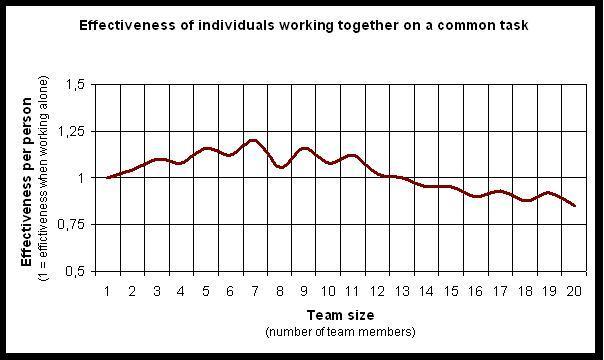
Super7 Operations uses small teams of 5-9: average 7 persons. Why did we chose this team size?

The optimal team size for Lean working – a question that keeps popping up. In several recent publications on SCRUM (e.g. articles on Scrum.org or informit.com), an optimal team size of 7 plus or minus 2 (that’s 5 to 9 to you and me) is mentioned. Stephen Robbins, author of Essentials of Organizational Behavior (2005), a best-selling textbook on organizational behavior, has concluded that teams of more than 10 to 12 people have a difficult time establishing feelings of trust, mutual accountability, and cohesiveness. Without these, constructive interaction is difficult. At the SPA 2009 conference, Joseph Pelrine told his audience that the sizes 5, 15 and 150 have been mentioned in (or can be derived from) scientific research, as being optimal sizes for social groups. To me, 150 sounds to big, and impractical for an autonomous team. And then there are people that are convinced that a team should have an odd number of team members, so that a democratic decision will always have a majority. And then there is the principle of social loafing, first demonstrated by psychologist Max Ringelmann in the 1920s when he measured the pressure exerted by individuals and teams pulling on a rope. Groups of three exerted only two-and-a-half times (not three times) the average individual pressure. Groups of eight exhibited less than four times the individual average. Ringelmann’s and related studies have shown that individual effort is inversely related to team size. But is effort the same thing as effectiveness, especially when the work is not so much physical but requires intelligence and judgement? My analysis, based on all of these sources and my own experience in Lean-teams, results in the following graph. With the introduction of Super7, we discovered that a small team of about 7 people works great. What do you think?Graph team size