Flexibility to cope with fluctuation: what does this mean for employees?

Customer demand can fluctuate enormously: with Super7 Operations, we try to cope with the fluctuation by making our operations capacity as flexible as possible. But what does this mean for the employees? Perhaps it’s good to share our experiences from recent implementations of Super7 Operations within a large Dutch retail bank.

Because the work is planned on forecast, the small autonomous Super7 teams have some idea in advance of how much capacity they need to deliver each day. The more accurate the forecast is, the easier it is to create a roster that everybody is happy with.  But planning ahead on forecast isn’t easy. The reality is that the actual working hours per day can be somewhat unpredictable. Naturally, this doesn’t always mean working longer, there is an equal chance of going home earlier because there is less work than planned.

The reality is that working predictable hours isn’t possible anymore. The truth is that customers in financial services expect faster response and better service than before the banking crisis.

The team members within a Super7 team can help each other out and compensate when one of the team members needs to be home on time. This can’t be a daily recurrence, however. For people with young children, this often means that they need to find back-up arrangements with their partner, neighbors or grandparents to pick up the kids from the daycare, for instance.

In a recent survey, employees were asked if the felt that their work/life balance had changed – worsened or improved – since the introduction of Super 7 Operations. The result was twofold: very few people responded that the introduction of Super7 Operations hadn’t influenced their work-life balance. About half of the respondents indicated that the balance had worsened. But on the other hand, an equal part indicated that it had improved. For some, the plus-side of working shorter on quiet days outweighs the down side of working longer when necessary. And for others, flexibility results in challenges in the strict schedules of home and family.

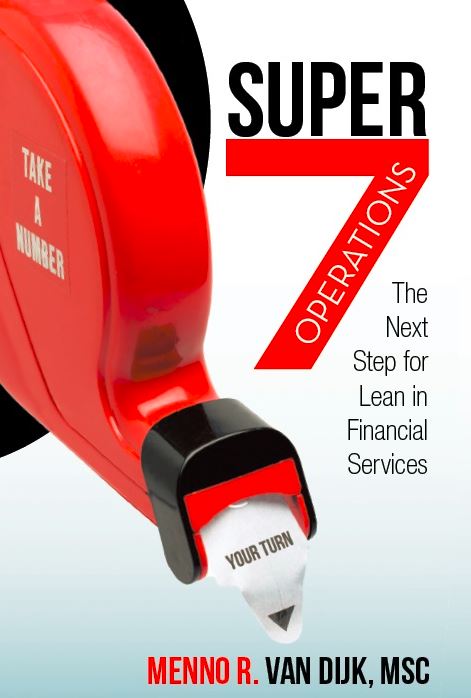
More on this topic can be found in my recent book: Super7 Operations – The Next Step for Lean in Financial Services. Available on Amazon.com, or for European readers Amazon.co.uk, Amanzon.de  or Amazon.fr.

Super7 Operations - the Next Step for Lean in Financial Services ; a book by Menno R. van Dijk
Super7 Operations – the Next Step for Lean in Financial Services ; a book by Menno R. van Dijk


How to apply Super7 Operations without TITO

Is Super7 Operations possible without TITO, you might wonder? (Or, “What’s a TITO?”)

In my book on Super7 Operations (Super7 Operation – the Next Step for Lean in Financial Services), I describe the development of Super7 Operations – Lean and Operational Management with small autonomous teams. One of the crucial things in Super7 Operations is that there is a daily goal for each small autonomous Super7 team – one that they can reach by working together, by helping each other. In the first departments where Super7 Operations has been introduced successfully, this goal was to work TITO: Today-In, Today Out. All customer requests that are received today are processed today -finished today, the customer shouldn’t have to wait.  The team’s common goal is: finish all customer requests that you receive today or at least those that you receive up to one hour before closing time. The fluctuation in ‘demand’ isn’t buffered with inventory, but is answered with sufficient flexibility in capacity.

Recently, Super7 Operations was introduced in several operational departments where the nature of the work made it impossible or extremely impractical to work TITO. Request that take more than one day to process, in one instance. In another, extreme peaks and lows, with almost all requests of one month coming in in one single batch (Naturally, batches are evil (to summarize one of the principles of Lean to the extreme).  But sometimes batches happen).

We have found that it is possible to work with other daily goals than TITO. This requires more sophisticated planning, for one, to translate the total demand into daily goals. Working with goals like TITO+5 doesn’t work, as we experienced. The team needs to have a clear goal for each day, which is higher when demand is high and lower when demand is low. Only then you get the commitment, improvement and cooperation that you expect from Super7 Operations.

If you’r interested in how this planning for daily goals works, please drop me a note below. I can give you more details, if you want. Or, you can join the discussion on www.super7ops.com

Maturity Model for Autonomous Super7 Operations Teams

At this moment, Super7 Operations (link) is applied within several operations departments of one of the leading Dutch retail banks. A lot has been learned since. The change from strict daily steering to small autonomous teams –and at the same time keeping all the good things from LEAN and Operational Management – has asked a lot from both the shop-floor employees and their managers. What we noticed is that teams go through several phases, or maturity levels, in their journey towards autonomy. And, team managers need to grow towards supportive leadership and output steering – this too doesn’t happen overnight. 

When we recognised this, it became clear that a maturity model would be very helpful. With this, the transition can be broken up into smaller, more manageable steps. And, for each maturity level, specific training and coaching can be developed to support both managers and Super7 teams.

The maturity model is still a work in progress, and at the moment only available in Dutch. If you’re interested nonetheless, you can request a copy by replying to this post. And, I expect to be able to post an English version of the Maturity Model for Autonomous Super7 Opertions Teams on this site shortly.

I would like to hear your experiences with the development of autonomous teams. You are invited to join the discussion on Super7 Operations on http://www.super7ops.com/

A new book on Super7 Operations!

Super7 Operations –  a book by Menno van Dijk 

(tip: clik the link above ↑ to buy the book at amazon.com)

 Naamloos


“Why did you decide to write this book on Super7 Operations?”

–          “To me, Super7 Operations is the logical next step for LEAN in financial services. I’m proud that we developed this innovation within ING. I’m so enthousiastic about it, it would be fantastic if this innovation would spread across the financial world. So much more can be achieved with LEAN than cost reduction alone. LEAN can become the culture within which people truly work together to improve every day.  That’s the foundation of Super7.  We believe in the abilities of our people, we trust them and give them responisibilities, and we steer on output. This improves the service to our customers. And, LEAN becomes FUN again! I had to write a book about Super7 Operations, to give as much people as possible the chance to learn about it.

“What were the reactions so far?”

–          “Very positive indeed! That started already with the publiser: the book was selected as “Editors Choice”,  something that I’m very proud of. And the feedback that I have received from readers has been great too.”

“Are you planning to write more in the future?”

–          “Well, we have been working on developing Super7 Operations further within ING. The method has been introduced in much more teams, some with totally different type of work than where Super7 Operations first was developed. For instance, what do you do when TITO (today-in-today-out) isn’t possible, when the nature of the work is such that it takes more than one day to complete it? This requires a different way of setting daily goals.  These developments may make a  great addition to the existing book, maybe for the second edition?”

OEE sets the standard for improvement metrics

Which way to improve? OEE gives directions!One of the best ways of getting people to cooperate is to give them a common improvement goal. And OEE is the best example of what a good metric for improvement should look like.
The best example of cooperational excellence I’ve encountered so far is production teams working together to improve the performance of their production line. You could argue that the fact that a team of operators work on operating the same piece of equipment imposes the need to cooperate. The effect of improving together is much stronger, to my experience. And OEE – Overall Equipment Effectiveness – is, to my opinion, the best gauge you can give a production team for this purpose.

The theory of OEE
In short, OEE is defined as the time a production line is running effective (i.e. producing to quality standards at the rate it was designed for) as percentage of the total time that is available within a certain period. For example, for a a printing line producing printed forms OEE is calculated as follows:
Total production last week: 500 boxes of forms
Total time that would be required for production of 500 boxes, when the machine would have run at the speed it was designed for, without stops: 24 hours (= effective machine time).
Total time in the last week (opening hours of the factory): 120 hours (= total time)
OEE = effective machine time / total time = 24 / 120 = 20 %
But there is more.
OEE also shows you where the unproductive time went: the 6 big losses (of which there are actually 8)
Frist, there are2 Planning losses:
– Scheduled maintenance
– No orders or no materials available
Secondly, there are2 Availability losses:
– Set-up time
– Technical break downs of the machine line
Then there are2 Speed losses:
– Machine is running at lower production rate that it was designed for
– Short stops (paper jams, etc.)
And finally, there are 2 Quality losses:
– Machine is producing products that aren’t meeting the specifications (rejects)
– Products produced at the beginning of a run, while the machine settings are adjusted

What’s so great about OEE
One great thing is that all time is accounted for. It is impossible to manipulate the system. E.g., if you don’t register a technical break down, the time loss will end up in your speed loss.
Another great thing is that calculating improvement potential is easy (but not relevant for this story today).
But the very best thing is that a standard improvement approach is available for each type of loss. This helps the production team enormously in their improvement efforts. At any moment, they can start a kaizenning (improving) on the biggest of the 6 (i.e. 8) big losses, and by choosing the loss they want to address, they automatically know how to improve it.
For instance:
For set-up time reduction, there is the SMED method (Single Minute Exchange of Die): videotaping the set-up and eliminating all the muda out of the time that the machine doesn’t run.
Technical break downs can be prevented by introducing TPM (Total Productive Manufacturing)
The machine speed can be improved by – and this is a fun thing to do – step-wise increasing the speed until something goes wrong, watching closely what it is that goes wrong, and then finding a solution for what goes wrong.
And so on, for all the losses.


OEE sets the standard for all measurement systems
When you introduce a system of metrics, intended to help improving your team’s performance, OEE sets the standard. See if you can create a closed balance, where registration mistakes don’t effect the overall performance metric. And, more difficult but also even more valuable, design a standard improvement approach for each of your non-productive categories.
In my time as a Lean Manufacturing consultant, I’ve introduced OEE within numerous production companies, and it still is the standard for production lines. You don’t need a sophisticated manufacturing execution system (MES) for it (unless you’ve already got one, of course). When you know OEE and your production line, Excel and time registration forms are quite sufficient.
Introducing a similarly good metrics system in for instance service environments, that’s always an interesting puzzle!

Super7 Operations at ING: nominated for the NCCA innovation award 2013

NCCA innovation award nomination for Super7 Operations at ING. Super seven operations has succesfully been introduced within ING. So succesfully, that ING has been nominated for the NCCA innovation award 2013. ING didn’t win, but being nominated is quite an achievement. This nomination shows the potential and the innovative character of Super7 operations!

Watch the video about the nominated ING case below: The NCCA jury presents the nominated cases (in Dutch)

link

Super7 Operations – the next step for Lean Operational Management

Super7 - the next wave for operationsSuper7 Operations, an innovative way of using Lean in back-offices, proves to be the next step after Lean Operational Management. Cooperation is a key ellement of Super7.

I have been always amazed by what is achieved when a production team, with operators and maintenance engineers working closely together, improves their own production line step-by-step. I’ve seen this many times, in my 15 years working as a Lean consultant. The first signs of improvement appear after the team gets training and starts applying the principles of Lean. The team finds the first quick wins, and immediately, this creates enthusiasm and momentum. The real transformation happens, however, when the team begins to truly cooperate. They become an improvement team, committed to improve performance, making optimal use of the strengths of each of the team members. When they really get going and continuous improvement starts, it’s just wonderful to witness.

I’ve been working as a Lean and Lean Six Sigma for a decade and a half now. Over the years, I’ve introduced the concept of improvement teams within a dozen production companies within The Netherlands, and a couple in Germany. In these multi-disciplinary teams, people from different departments work together on the single task of improving a production line, making it run faster and smoother, reducing down-time and break-downs, etc. As a team, they have the flexibility to cope with any production problem that can occur. For me, the people on the shop floor aren’t ‘resources’ that need to be ‘managed’, but creative and knowledgeable individuals, that can do great things, especially when they truly work together. Recently, I implemented these ideas in a financial service back-office in what I and others feel is an innovative way– the Super7 operations principle.

My book on Super7 Operations, with information on what Super7 Operations is, how it works and how you could apply it in your own work environment, is expected to be published within a couple of months. I’ll keep you posted – on www.super7ops.com!

Optimal team size for Lean is seven: Super7 Operations

Super7 Operations uses small teams of 5-9: average 7 persons. Why did we chose this team size?

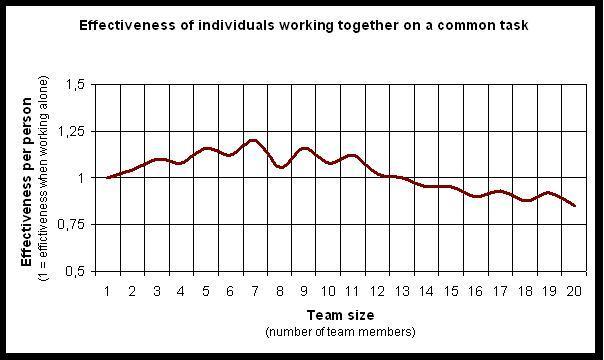
The optimal team size for Lean working – a question that keeps popping up. In several recent publications on SCRUM (e.g. articles on Scrum.org or informit.com), an optimal team size of 7 plus or minus 2 (that’s 5 to 9 to you and me) is mentioned. Stephen Robbins, author of Essentials of Organizational Behavior (2005), a best-selling textbook on organizational behavior, has concluded that teams of more than 10 to 12 people have a difficult time establishing feelings of trust, mutual accountability, and cohesiveness. Without these, constructive interaction is difficult. At the SPA 2009 conference, Joseph Pelrine told his audience that the sizes 5, 15 and 150 have been mentioned in (or can be derived from) scientific research, as being optimal sizes for social groups. To me, 150 sounds to big, and impractical for an autonomous team. And then there are people that are convinced that a team should have an odd number of team members, so that a democratic decision will always have a majority. And then there is the principle of social loafing, first demonstrated by psychologist Max Ringelmann in the 1920s when he measured the pressure exerted by individuals and teams pulling on a rope. Groups of three exerted only two-and-a-half times (not three times) the average individual pressure. Groups of eight exhibited less than four times the individual average. Ringelmann’s and related studies have shown that individual effort is inversely related to team size. But is effort the same thing as effectiveness, especially when the work is not so much physical but requires intelligence and judgement? My analysis, based on all of these sources and my own experience in Lean-teams, results in the following graph. With the introduction of Super7, we discovered that a small team of about 7 people works great. What do you think?Graph team size


Is the LEAN-hype in Financial Services over?

Super7 operations builds on the principles of Lean. The recent succes of Super7 operations within Financial Services raises the question: is the LEAN-hype in financial services over, or are companies waiting for the next big thing: super7 operations?

My conslusion, after researching recent publications, is: no. Although the banking crisis forces banks to re-think their business, their proposition and their priorities, LEAN, with it’s core elements of continuous improvement, waste reduction, process thinking and customer centricity are still key elements in the strategy of a large number of leading banks.
 
In today’s global business world, companies are relentlessly looking for ways to cut on waste and gain an edge in an increasingly competitive market. Lean manufacturing practices have been successfully adopted by manufacturing firms with remarkable positive results in streamlining production processes. Nevertheless, as recent trends show lean strategies are no longer the preserve of manufacturing companies alone; service companies and innovation firms have picked up these tenets in order to eliminate process waste, enhance customer value and spur continuous improvement.


Adoption of Lean Strategies in the Financial Industry 
Despite the numerous benefits that financial institutions can accrue if they adopt lean management strategies, in practice the uptake has been laggard. This can be largely attributed to the false perception held by most business leaders that lean concept, being process oriented, offers very few benefits for the service industry in general. Couple this with its Toyota Production System origins, and lean as a concept of production becomes ‘unattractive’ to most financial service industry leaders.

 On the other hand, there has been tremendous hype on how lean manufacturing strategies can transform and reform the financial services industry into one that is more efficient and customer oriented. This statement should be viewed from an observer point of view to appreciate the predicament financial institutions are currently facing. These include increased calls for customer-focused services, efficient processes that lead to cost cuts, and increased demand by shareholders for higher cost-benefit ratios in investments.

 Impact of Lean Management Strategies in the Financial Sectors.

 According to a recent research conducted by The Boston Consulting Group, banks and other financial institutions that successfully implement lean programs record 15% to 25% improvement in overall efficiency. The study concludes that despite market jitters by financial institutions regarding lean practices, with time as more players in the industry discover and profess the benefits of lean operations- for instance reduction in costs, improved efficiency and faster service turn around- wide scale adoption is inevitable.

 In order not to be left behind, banks, investment firms, credit unions and insurance firms are adopting lean practices. GE Capital, JP Morgan Chase, Citigroup, American Express, Sun Trust Banks and BNP Paribas are just a few of the financial institutions that have successfully implemented lean management strategies. Initially, lean practices were mostly deployed in call centers, customer delivery channels, and other back office operations. However, lean strategies are continuously moving up the value chain, and are showing remarkable application opportunities in trade processing and finance reporting sectors.

 Supporters of the adoption of lean strategies in the finance industry argue that manufacturing and finance industries are not that different, since both depend on processes. In regards to this, a lean concept is not industry specific but process oriented, allowing multi-sectorial adoption. Basically, lean entails identifying and eliminating waste in processes leading to cost cuts and performance excellence. Waste is defined as anything that doesn’t add value to the final product or service. The seven types of waste that the concept recognizes are: overproduction, transportation, waiting, defects/rework, over processing, inventory and unnecessary motion.

 Challenges of Adopting Lean Strategies in the Financial Industry

 Implementing lean principles in the financial industry is not an easy task. However, implementers should focus more on people rather than processes, and adopt a top down performance improvement approach which is more programmatic. Nevertheless, lean principles have significant limits, especially when they are implemented in the financial industry. For instance operational systems in the financial industry are less standardized as compared to other industries. Take for example; customer service expectations vary depending on education level and income, this makes it difficult to establish standardization across all the branches. Another challenge is that adopting lean concepts in a service industry results in the customer being the driver of the service process. This inevitably complicates matters and at times causes unnecessary tensions between employees and customers.

 As pointed out earlier, the lean agenda in the finance industry is market driven, leaving very little leeway for industry players to ignore. Without a doubt, lean strategies are moving up the value chain in the finance sector as institutions search to adopt next generation management strategies that lead to efficiency in work processes.

 References:

 http://hbr.org/2011/10/lean-knowledge-work/ar/1

 http://knowledge.wharton.upenn.edu/papers/download/101109_SS_Rethinking_Lean.pdf

 http://oper3210-lean-concepts-f08.wikispaces.com/Finance

 http://www.fsokx.com/ResearchData/IndustryInsightsDetail.aspx?id=97&CT=KC

Case study – Cooperational Excellence within a small consultancy team

Can you create excellence through teamwork in a consultancy environment? The best way to see if something works is to try it. So that´s what I did last year, with help of my colleagues: a pilot within the team that I was a part of at the time. Could we increase the quality of our individual assignments by applying the concepts of Cooperational Excellence? Read my in-depth case study in the White Papers section.

Summary
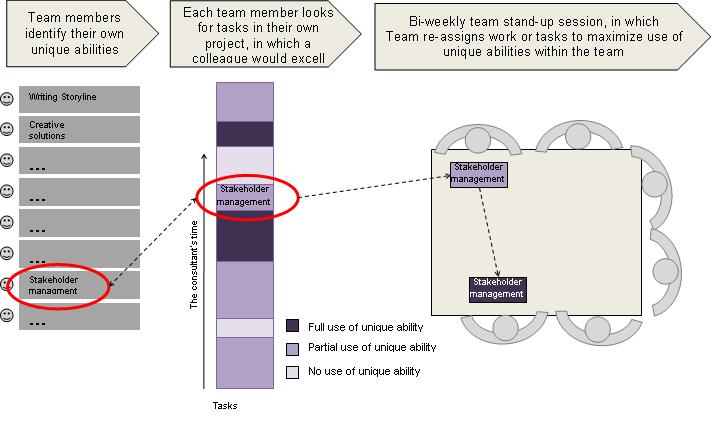
Consultants help each other, by contributing on each others projects. In a project, there may be activities that the consultant doesn’t like doing, or isn’t very good at. The solution is NOT that the consultant asks help with these activitiesIn a project, there may be activities that the consultant does an average job of – good enough, but he doesn’t excel in it. While this same activity is something that a colleague does excel in. The project will benefit if this colleague helps with this particular activityThe idea is, that every consultant has his own unique abilities – or their own activities they excel in – and the whole team will benefit if each consultant can make more use of their unique abilityWhen every consultant asks help for his/her project, based on the unique ability of the consultant he/she asks for help, the average time that each consultant uses his/her unique ability will increase


Conclusion

In those instances where it was possible to find a match between an activity and a unique ability, the pilot showed that this concept works

The difficulty lies in finding enough matches, so that everybody benefits

More details and quotes from participants can be found in my White Paper: Cooperational Excellence in Consultancy